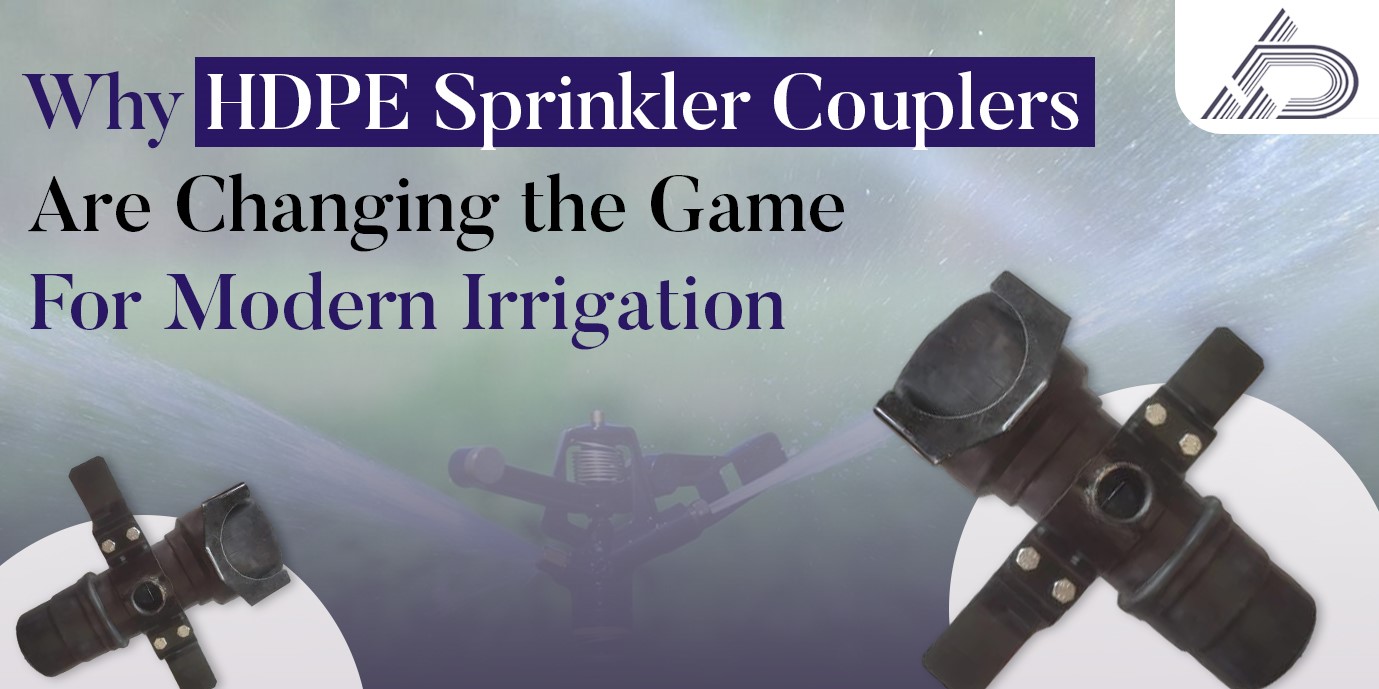
In the ever-changing face of agriculture in the year 2026, the HDPE Sprinkler Coupler has proven to be the foundation of effective water resource management. With the growing scarcity of water resources around the world, the need for irrigation precision has never been more acute. The parts that bring our lifeline together—the pipes—must be stronger than ever before.
For the farmer and irrigation engineer, a "good enough" solution is a formula for disaster. High-quality couplers from a leading industry expert such as ADM Engineering will ensure that your sprinkler system is always leak-free and flexible, even in the most challenging agricultural terrain.
What Constitutes an HDPE Sprinkler Coupler?
HDPE couplers are innovative fittings that are designed to connect sprinkler pipes effectively and disassemble quickly. These couplers are unlike other sprinkler fittings because they are designed to withstand the chemical and physical challenges of the field. The essential components of these revolutionary fittings are:
- The High-Density Resin:The basic raw material that has high impact strength and UV resistance.
- The Locking Mechanism: Usually a latch or a hook that can be connected without any tools in seconds.
- The Sealing Gasket: A precisely designed rubber ring that provides a tight seal under different pressures.
- The UV Stabilizers:Chemicals added during the manufacturing process to make the plastic resistant to brittleness from the 2026 sun.
Step-by-Step: The Impact of HDPE Couplers on Irrigation
To understand why this technology is a "game-changer," let’s break down how an HDPE Sprinkler Coupler operates within a modern irrigation setup.
1. Quick Field Installation
In 2026, time is as precious as water. HDPE couplers enable farmers to install irrigation lines that are kilometers long in a matter of days, compared to solvent-welded or metal pipes. The light weight of HDPE enables a single person to handle several pieces of pipe easily.
2. Pressure Handling
As water flows into the pipe, the pressure varies. A good coupler is engineered to "seat" better under increasing pressure.
- Capability: ADM Engineering employs precise molding techniques to ensure that the coupler body retains its shape even under high-PSI pressure surges.
- Value: This helps avoid "blow-outs," a common problem with substandard plastic couplers, thereby ensuring that every drop of water reaches the sprinkler head and not the coupler joint.
3. Terrain Adaptability
Farms are not flat. HDPE couplers offer a degree of angular flexibility at the joint, which enables the pipe to conform to the natural topography of the land without the need for costly elbows and couplers.
4. Weather and Chemical Resistance
Contemporary farming practices involve the use of fertilizers and pesticides that are corrosive to metals. HDPE couplers are chemically resistant and will not rust, scale, or corrode, no matter what is being pumped through them.
Why Material Quality Matters in 2026
The sustainable and smart revolution in agriculture has set new standards for irrigation equipment.
1. UV and Heat Resistance
With record-breaking temperature fluctuations in 2026, common plastics may break down in just one season. ADM Engineering’s couplers are carbon black and UV-stabilized to guarantee flexibility and durability even after several years of exposure.
2. Leak-Proof Technology & Precision Engineering
In the age of “Precision Ag,” every drop of water is accounted for. Even a pinhole leak in a coupler can throw off readings and waste precious liquid fertilizer. Couplers are now tested for zero-leakage at pressures beyond normal operating conditions to guarantee a “Data-Driven” harvest.
3. Sustainability & Recyclability
With increasingly strict environmental regulations, HDPE is a clear winner for its high recyclability. Using HDPE instead of heavy metals will minimize the carbon footprint of the irrigation system and make it easy to upgrade equipment at the end of its long life cycle.
Key Features of an ADM Engineering HDPE Coupler
While assessing your irrigation equipment, it is essential to check whether your supplier satisfies the following 2026 standards:
- Tool-Free Assembly: Latches that are easy to use with one hand, even when wet.
- Corrosion Immunity: Protection against fertilizers and soil chemicals used in contemporary high-yield agriculture.
- Standard Compatibility: Couplers that work perfectly well with the present HDPE pipe sizes used worldwide.
- Impact Resilience: Thick-walled designs that can resist being stepped on or struck by light agricultural machinery.
Why Choose ADM Engineering?
At ADM Engineering, we are a front-runner in the irrigation and engineering industry, and we offer the dependability needed for the future of farming:
- Engineering Excellence: Our couplers are designed with advanced fluid dynamics to provide the least amount of pressure loss at the point of connection.
- Quality Control: Each production lot of HDPE Sprinkler Couplers is thoroughly tested for pressure resistance prior to shipment from our warehouse.
- Industry Knowledge: With extensive experience in the agricultural backbone of the country, we are well-versed in the unique demands of the Indian climate and soil.
- Scalable Solutions: Whether you are tending to a small organic farm or a large industrial farm, we have the hardware to match your size.
Conclusion
The HDPE Sprinkler Coupler manufacturers is the unsung hero of the modern farm. In the year 2026, where efficiency is the measure of profitability, these parts offer the long-lasting and leak-tight performance that conventional irrigation systems cannot hope to provide. By choosing to work with a committed supplier such as ADM Engineering, you can be sure that your irrigation system is designed to withstand the demands of the present and the advancements of the future.
Frequently Asked Questions
Yes. They are ideal for portable "shift-and-spray" systems because of their quick-lock mechanism and can also be used in semi-permanent systems due to their durability.
With proper UV protection, high-quality HDPE couplers from ADM Engineering can last up to 10-15 years even in direct sunlight.
Yes. However, the gaskets inside the coupler need to be checked, especially if the water is high in silt, to ensure that the seal is clean and watertight.
HDPE pipes are measured by outer diameter (OD). Simply match the coupler size (e.g., 63mm, 75mm, 90mm) to the OD of your existing irrigation pipes.